Thursday, August 18, 2016

Let the Weak Shame the Strong: Hunger Games as Inspiration for Youth Ministry (Archived Post)

       Now that I am working with youth ministry again, and also preparing for next month's post (here), which includes discussing the dystopian parody of Ancient Rome found in The Hunger Games, I was reminded of this piece written a few years back, while serving at Epiphany Parish in Normal, IL and working extensively with youth ministry.  The first movie had just released a few months prior and I had chosen to use "Holiness Games" as the theme for the youth ministry semester kick-off.  What follows is from a letter I wrote to the youth and their parents, explaining why I chose The Hunger Games as inspiration...


Of all movies, music, catch-phrases and other popular things in culture, why draw inspiration from The Hunger Games?  Well, the meaning found in art may or may not be intentional on the part of the artist.  Nonetheless, there are different degrees to which different artists intend to transmit meaning in their work.  I do think, however, that the more we open our eyes to meaning the more we will become convinced that there is hardly anyone out there, indeed if anyone at all, singing songs, writing them, making movies, etc., who has nothing to say.  And this need not be approached with distrust as if it were merely an agenda; maybe it is simply the case that they believe they have found some meaning in life.  Generally, however, we cannot know the intent of the artist with absolute certainty, unless they communicate it to us directly.  Some, however, are so bold in the symbols they use and the way their stories develop that it is highly unlikely that they did not intend to communicate meaning.  Perhaps one of the clearest examples is C.S. Lewis’ The Lion, the Witch, and Wardrobe.  Few people who know the story of Christ and His Death and Resurrection for our salvation would fail to recognize this meaning present in Lewis’ classic, and to presume some intention on his part.  Well, Suzanne Collins (the author of The Hunger Games) has crafted quite a different story and her meaning is a bit different, but the meaning found in her pages does appear to be quite bold. 

The Hunger Games is quite a dark story set in an equally dark world.  Yet, in many ways, the cruelty and horror found in Panem – the country in which the story is set – is nothing original.  In fact, as the books proceed, Collins begins to make some more explicit references to ancient Rome, including a conversation in the third book (Mockingjay, pg. 223) about the old expression Panem et Circenses (Latin for “bread and circus” – notice that panem was already found in the name of the country), which referred to the fact that the people of Rome were satisfied by the fact that they were given food and entertainment, and thus their concern for the welfare and government of their own country were appeased and silenced.  Never mind the fact that their entertainment was the brutal killing of human persons!  In Panem, the Games which satisfy the masses are centered around, not only the killing of human persons, but of the poorest and weakest: children from the various districts, segregated on basis of wealth and poverty.  One can readily see the connection between this and abortion – the killing of the poorest and weakest members of our society, children who are not yet even born.  However, there is even more still at stake here (at this point, I will remind all readers that I do not necessarily claim that the thoughts that I put forth are necessarily the thoughts or intention of Suzanne Collins).  In order to appease the selfish appetites of those who believe that true freedom means that no one can stop them from doing whatever they please (rather than being freedom from their own passions, in order to choose what is truly good for themselves and for society), those who currently hold power and influence impose their views upon our children, attempting to create a new social norm that is even to be protected in law, by which anyone who believes differently than they do is accused of hate.  Once upon a time, law was given to us in order to provide a structure and guidance that enabled people to choose what is truly good for themselves and for society, and likewise penalties were given for the sake of promoting the common good, by discouraging that which is opposed to it.  Most importantly, it was a reflection in human society of the Divine Law, the beautiful order with which our Creator designed His creation, in order to guide us back toward Himself.   Now, however, the pervading attitude toward law in our culture, and even in many areas of our government, is a means of removing any such structure that may provide an obstacle toward an individual’s ability to do whatever he or she pleases, regardless of whether it is truly good for them or for society, and penalties are given (disregarding actual freedoms of speech and religion) in order to punish those who wish to believe in something called the true good.  We can see this not only in recent actions by our federal government, but in the attitudes promoted in many schools, in media, and even in the fact that Disney movies seem to have been promoting non-traditional families for many years.  The attempt to normalize the notion that there is no true good and that anyone who wishes to believe otherwise, and is public about such beliefs, is guilty of “hate,” is truly a way of killing our youth, spiritually, morally, and often psychologically, by teaching them that faith is something that deserves punishment, and all of this so that others can satisfy their desire to do as they please.  All of this goes on while so many of us enjoy a comfortable existence, with our needs of food and entertainment (panem et circenses) satisfied.   

It is clear that the state of affairs in Panem is meant to be seen as a horrific thing.  For all of its violence and messiness, the story does not promote violence or the evil that is depicted.  In fact, quite the opposite, from the very beginning of the movie, death seems to loom over the whole scene.  And this continues to pervade, as it builds toward the point in which the Games finally begin.  The violence of this scene is hardly glamorized; it is portrayed with a horror, that is not meant to entertain, but to help us to recognize how starkly this contradicts the dignity of the human person.  It should be noted that the dignity of human life is a theme that comes up often in the series.  However, there are also points in which Collins fails to be consistent, as her attitude toward certain other crimes against the dignity of human life is far less laudable, and even unacceptable.  (For more information on this, I recommend a review by Fr. John-Mary Bowlin, a priest of the Diocese of Tyler, Texas, entitled The Hunger Games: Reflections of a Spiritual Father for the Evangelization of Culture; read the whole thing here).    
     
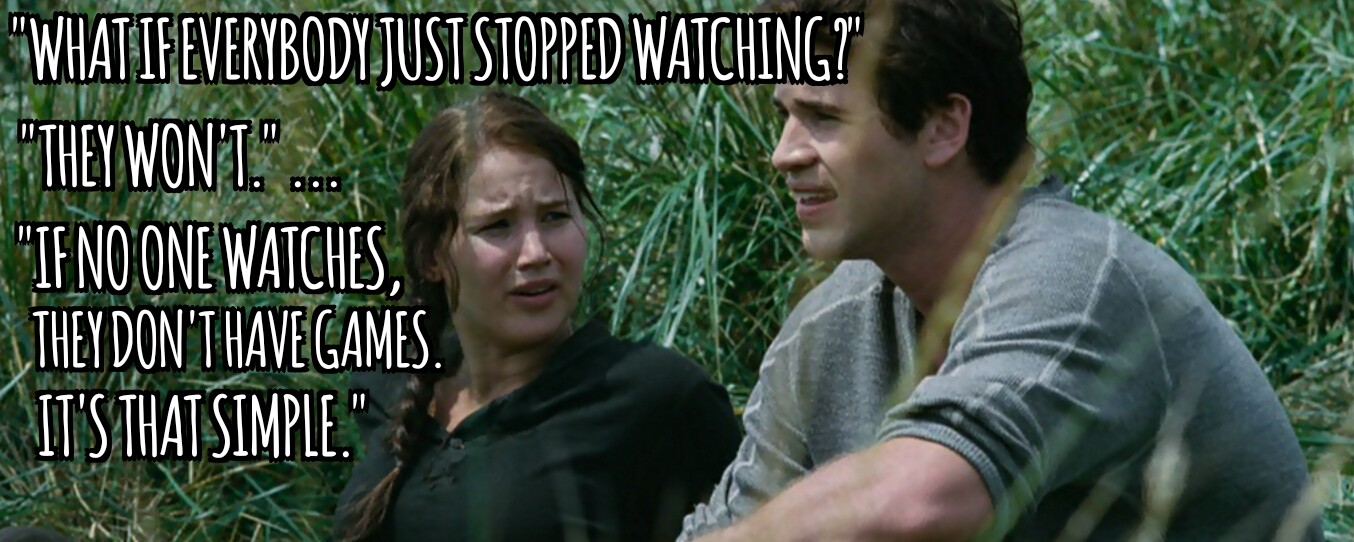
Perhaps, however, the boldest aspect of this dark world depicted by Suzanne Collins in The Hunger Games is the fact of how they got this far.  In the words of Fr. Bowlin (here), “The political state of affairs in Panem is the result of complacency.”  It is the result of people sitting back and doing nothing, because their basic needs of food and entertainment (panem et circenses) are satisfied, because they fail to look beyond themselves and to recognize the dignity of those who are suffering and dying.  This fact comes across boldly in The Hunger Games series, as you see the obliviousness, selfishness, and vanity of the audiences and hosts in the Capitol.  Perhaps the most clear and powerful point in which this is communicated is in the third book, in which one of the characters comments: “Actually, the whole country just sat by and watched,” and the other replies, “Well, that’s what they do best” (Mockingjay 222).  How long will we sit back and watch while the world that our children are inheriting is being violently transformed into one in which selfishness has taken the place of true freedom and goodness?  Dare I suggest that even our indifference to meaning in art and entertainment contributes to this complacency that amounts to just sitting by and watching it all go down? 


But, for all of this darkness, where is the hope in The Hunger Games?  It is found in the fact that the youth of District 12, the lowest and poorest of the districts, stand up and refuse to be controlled by this wicked regime.  As the trilogy progresses, we see that, desperately grasping for justice in a broken world, they do not always turn to means that we can consider laudable or acceptable (again, I recommend the review of Fr. Bowlin).  So, let us bring this back to reality.  Let’s apply the Augustine Principle (see Seven Principles).  How is it that Christ fulfills the desire for goodness, justice, and true freedom in our broken world, which we see boldly reflected in Panem?  He chooses the weak to shame the strong.  He calls you, youth and adults alike, of our parish and of the whole Church, to rise up and refuse to be controlled.  He calls you to be saints, who make the world think twice.  This call to holiness, placed upon all of us, is about so much more than moral perfection, so much more than following one rule after another, jumping through hoops and checking it off the list.  It begins with faith.  It begins by believing that Jesus Christ alone is true and only He can satisfy the deepest desires of your heart for happiness, for truth, for freedom, and for love.  The moral decisions that come from a life of holiness flow from the fact that Jesus Christ is first in your life and you have come to know and believe with the faith of St. Peter: “Master, to whom shall we go? You have the words of eternal life.  We have come to believe and are convinced that you are the Holy One of God" (John 6).  This is the foundation for believing that His law and commandments, as hard as they may be to follow in a world that disregards them, are the only true path to happiness.  This is holiness: Allowing Christ to live within you.  This is the sort of life that refuses to allow itself to be controlled by the selfishness and vanity of the masses.  This is the life of those who stand up and make a difference… simply by living their lives to the fullest… in spirit and in truth.  This is the call the Lord gives to you.  This is why I have been saying it since I arrived at our parish and I will continue to say it: Youth, you are our secret weapon.  It’s time to let the secret out.


Saturday, July 23, 2016

We Know His Name, But Is That Who He Is?: Jason Bourne and the Question of Identity

     As a youngster, my friends and I would dabble in homemade movies.  Inevitably, perhaps due to our inability to replicate the kind of quality we saw in the movies we loved to go see in the theater on the weekends, we would fall back on trying to make them funny.  However, having both a penchant for drama and a healthy dose of perfectionism, I took my time trying to absolutely perfect my own script, which I would eventually contribute to colleagues for production, if it had ever left the brainstorming phase.  It was not only my overblown attempts at perfection that delayed pre-production.  It was also that the idea was scrapped when a new major motion picture arrived in the theaters.  As I watched the earliest trailers and read descriptions, my ire grew as I came to the conclusion, "That's my idea!  And theirs doesn't even look funny!"  My idea was a movie about a man with amnesia who, through various incidents of spontaneously discovering his own highly developed set of skills, comes to the realization that he was a master assassin.  The title would have been... wait for it... "Brain-Fart".  The film that killed it was The Bourne Identity.


     This frustration of feeling that Hollywood had beaten me to turning "my idea" into a reality led to my being adamantly against ever watching any of the Bourne movies for several years.  However, it was after the third installment was released that I was finally convinced by friends, who could not believe that I hadn't seen any of them, that I would find them worth watching.  I do not regret things unfolding the way they did because the result was that I had the pleasure of watching the entire Bourne Trilogy straight through for the first time all at once.  However, it was only after watching the first one that I realized that I had discovered a new series to be counted among my favorites.

     So, what is it that I find so intriguing about these movies?  The answer is simple: it is the ultimate action movie form of a story about a man seeking his identity.

     One common ingredient of a truly intriguing mystery is that it often engages the reader/viewer/listener with the question of who everyone is (including, but not limited to, the question of who the "villain" is).  Especially in those mysteries that contain an element of espionage, it often takes the form of "who are you really?" (like Ethan Hunt asks Brandt in Mission Impossible: Ghost Protocol). Sometimes, you may have a particularly provocative spy respond with something like, "Who do you want me to be?" (like Black Widow asks Steve in Captain America: Winter Soldier).  And then, you have the less admirable figures like James Bond, who consistently use this ability to do and be whatever the situation requires for his own selfish, often impulsive advantage.  In the midst of all this, here comes a man who simply wants to know who he is.  Yet, as the story develops, it invites the further question of "What if I don't like the answer?  Is it possible to change it?"  Thus, it opens up the deeper question: not simply "what is his identity?" but "what is identity itself?"  The big reveal at the end of the second movie - of his real name, David Webb - invites anyone who had not already considered it to ponder who he might have been before he became the master assassin, Jason Bourne.  This is a very fitting turn, at the end of a movie that showed that his attempt to leave behind the old self, which he gradually discovered over the course of the first movie, would not be so easily accomplished as the organization that created "Jason Bourne" will not let him go.


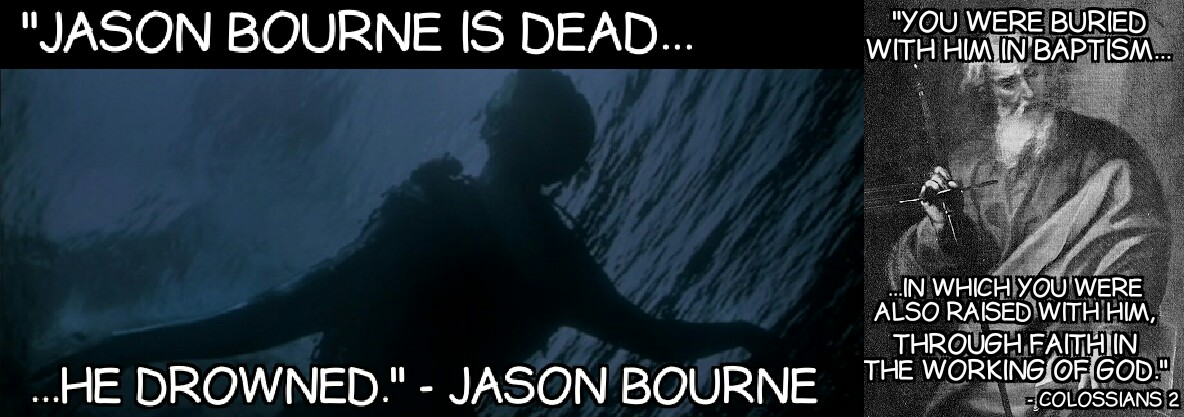
     It may prompt us to ask the question: is it really true that we cannot leave behind the old self?  How can we possibly live up to the great challenge of Saint Paul to put on the new man (Ephesian 4:24)?  Well, the first key to that is realizing that Saint Paul never intended that this be something we try to do on our own.  In the movies, Jason hopes to create a new identity for himself out of the sheer force of his will, violently reinforced by his unique skills.  However, it is striking that the image of his apparent death, which he tries to turn into an opportunity to begin again, is one of drowning, being immersed in water... not unlike the true source of new life and a fresh beginning: baptism.  Thus, it was not an accident that, when St. Paul spoke of putting on the new man, he told us to "put on the Lord Jesus Christ" (Romans 12:14), which is possible because we were "baptized into Christ Jesus" (Romans 6:3). Then, we may begin to realize that the question of how we can leave behind the old man does indeed involve the question of how we understand our identity.
   
    Another way of asking the question may be: is there a difference between who I am and who I have become?  Are we defined by our past?  Are we defined by our actions?  If we think deeply about the question we may arrive at the conclusion that there is a sense in which it seems to be true.  After all, isn't this reminiscent of what we believe about virtue?  Isn't it why we work so hard to overcome our bad habits and work to form good ones?  Do we not believe that, over time, our actions form habits, which form our character?  If this is true of virtue, is it not also true of vice?  Yet, we cannot escape the words of Saint John Paul II: "We are not the sum of our weaknesses and failures.  We are the sum of the Father's love for us and our real capacity to become an image of His Son Jesus Christ."  The answer to how the first half of the quote is possible - how we can have an identity beyond what comes from our actions - is found in the second half of the quote.  We first become "an image of His Son Jesus Christ," when we are "baptized into Christ Jesus."  This is when we become adopted sons and daughters of God, the Father.  For a Christian, this is our identity, the deepest truth of who we are.  Theologically, we refer to this 'deepest identity' as a sacramental character, imprinted upon our souls through the sacrament of baptism.  The goal of our efforts to grow in virtue - of forming good habits to replace our bad ones - is to allow our moral character to match our sacramental character.  For a Catholic, reinforcing those efforts with prayer and frequent use of the sacrament of reconciliation, which restores us to the grace given to us first at baptism, is the path to becoming a real "image of His Son Jesus Christ."

     So, the question of identity, which has always been central to the Bourne movies, is incredibly engaging for any soul who is seeking to know himself.  Perhaps even without suffering from amnesia, some of us may relate to the striking scene in the first movie, when he is pleading with the 'man in the mirror': "Do you know who I am?... If you know who I am, stop messing with me and tell me." It seems fitting to me that this latest installment is simply called Jason Bourne.  Admittedly, I cannot help but wonder if it was intended simply as a way of reclaiming the series after the recent spin-off, The Bourne Legacy, which was centered around a completely different character.  While I found the character of Aaron Cross to be an intriguing contrast to Jason Bourne, which could bring interesting things to the series, it is good to be reminded who this series is about, simply because it's about discovering who he is.  Yet, at the same time, it is a bit ironic that the name chosen for this new sequel is the name that signifies the old self, which he is always trying to leave behind.  Sure, a movie simply titled "David Webb" probably wouldn't do so well in the box office.  And I'm sure there will be an explanation for why he is now "resurfacing" in his old life.  Perhaps it will be a good reason, perhaps not (but I am hopeful).  Yet, it is striking that he uses the name given to him by those with whom he knows he needs and wants to disassociate.

     Generally, the name by which we are known is given to us by someone.  Sure, one can legally choose a name for themselves, or even attempt to give themselves a nickname (ask George Costanza how well that worked out for him).  But, these are exceptions from the norm.  Usually, we receive our name from our parents.  However, receiving a new name is often very meaningful.  In Scripture, we have moments in which God gives people a new name, marking a pivotal moment in the person's vocation, ranging from Abraham to Simon Peter.  However, the transformation of David Webb into Jason Bourne is of a very different sort.  It more closely resembles the renaming of the prophet Daniel and his friends in Babylon.  As if it were a way of telling them to leave behind their Hebrew origins, they were given new names, inviting them to identify with the land of their captors.  Yet, their Hebrew names were a reminder of their participation in the covenant with the Lord. Not unlike the names given to us by our parents signify our belonging to our family, their Hebrew names signified their belonging to God's family.  A name signifies, not only a person's unique individual identity, but also that they are a part of something bigger than themselves.  Similarly, when David Webb was given the name Jason Bourne, it was as if he was being told, "You belong to us now.  Your old family, your old life - you don't belong to them anymore.  You're ours."  He is given an indication of just how lonely this new life was during his interaction with one of the assassins sent after him at the end of the first movie.  Yet, it is only when he meets Marie, rediscovers relationship, and finally experiences a sense of responsibility to protect the children in the home where they have stowed away, that he finds the resolve to leave this past behind.

       The connection between identity and belonging is one of the most interesting elements of the first movie.  Although he begins by seeking in the mirror to find himself, it is only when he looks outside himself that he finds the answer.  As he searches for his identity, the longing to belong and the desire for a family begin to move to the forefront, culminating with their time with the father and his children.  Yet again, this calls to mind the wisdom of Saint John Paul II, who was frequently reminding us of the insight of the Second Vatican Council, that it is in giving ourselves away that we find ourselves.  None of us are made to live for ourselves, but to make of our lives a gift for others.  This can certainly be understood in light of one's vocation.  A man and woman give themselves away to each other in marriage, choosing to live for each other and for their children.  Men and women answer a calling to give themselves away to Christ and His Church in priesthood and religious life.  Yet, it can also be understood in a more general, day to day sense.  Regardless of our vocation, we have the daily opportunity to choose whether or not we will live for ourselves.  As Christians, we must recognize that these choices determine our effectiveness in leaving behind the old man, in bringing our moral character into line with our sacramental character, to live out our identity as a beloved son or daughter of the Father and a member of the Body of Christ.  Yet, like Jason experiences, our old life will not let us away that easily.  At times, we may even succumb to these temptations, in which cases we generally experience the sickening feeling of losing ourselves.  And when we really allow ourselves to drift far, far away, we realize that we have become something that is not true to the deepest truth of who we are.  But, the call always remains: "Remember who you are and to whom you belong, for whom you are living."  When we answer this call, the One to whom we belong waits to restore us to that identity, through the grace of the Sacrament of Reconciliation.

     I suppose it is no surprise that, even after so many years, David Webb finds that he still finds difficulty leaving Jason Bourne behind, especially if his desperate circumstance leaves him still alone.  But, we are not alone.  We belong to Another who is always inviting us home to recall who we are.  May we answer that call as often as we can.    

   
Idea for Bourne 7!
        

Tuesday, June 28, 2016

Cain and Abel Continued: The Good, The Bad and the Ugly of Hero vs. Hero Stories (Archived Post)

Unfortunately, due to technical difficulties, all of the the videos to the third Heart Speaking to Heart Symposium were lost.  What follows is a brief description of the presentation I gave...


"If this had been done by an enemy, I could bear his taunts... But it is you, my own companion, my intimate friend!" - Psalm 55


The relevance of the trend of "brother v. brother" or "hero v. hero" stories is especially prominent this year, as we have seen the two major brands of comic book superheroes (Marvel and DC) pit their two main heroes against each other in epic blockbusters.  It is a rather different concept, which causes a great many to flock to the theaters, while still plenty others scratch their heads and say "I don't get it.  Why are they fighting each other?"  So, it is worth taking a moment to consider what the implications are.  We can recognize a blend of positive elements, and others of which are rather alarming.


Still, there are certain false and dangerous ideas which these kind of stories could work to promote...


The above quote came from Fr. Barron's review of Avengers: Age of Ultron.  As I expressed in my own review (here), I have a different perspective, and the difference seems particularly relevant.

Fr. Barron's (now Bishop Barron) description of the Nietzschean idea of 'beyond good and evil' is very helpful, as are his warnings of the potential implications within the movie.  However, his overall perspective on the movie seems to be...

Movie = Nietzschean Parable
The character of Vision = Nietzsche's Mouthpiece

He describes Vision as: “produced by the flexing of the all too human will to power… this pseudo-savior was brought about by players on both sides of the divide, by both Iron Man and Ultron. Like Nietzsche’s superman, he is indeed beyond good and evil.”

My initial response is in the words of the Vision himself...


Furthermore, as I stated in my own review: "One of the gifts of (director) Joss Whedon is to use the dynamic of each diverse character in the ensemble to offer different perspectives on themes of human life and society.  You should not look to a Whedon movie/show (or I would add to any good story) expecting that any one character has all the answers or is responsible for spoon-feeding us the message we are supposed to take from it.  I’m pretty confident that's not how Whedon operates, and I'm thankful for that."

So, my general view in response is...

Vision ≠ Nietzsche’s Mouthpiece
Movie = complex reflection of human nature, brokenness and redemption

The importance of these perspectives to the current presentation lies in the fact that Age of Ultron introduced the idea of calling into question who the villain is (especially because the villain was created by one of heroes), showed the evil that can result when mistrust seeps in among the heroes, and generally was among the most important movies, which set the stage for Marvel's big 'brother v. brother' movie: Captain America: Civil War.  So, it matters going in whether or not they have already introduced this Nietzschean notion as the predominant philosophy underlying the larger story.  I would argue that they have not done so.*

Last, but not least, the final value of this type of story is found in considering stories like the prodigal son and Jacob and Esau...


*Now, having seen the movie, I do not think this philosophy was pervasive within.  I do think, however, that one of the biggest weaknesses was that it tended toward relativism, as Captain America's motivations were rather weak and not as grounded in truth as they ought have been.  For more on that, I recommend this article.  While I'm at it, here is a good response to Batman v. Superman, with which my thoughts resound.


Monday, May 2, 2016

With Great Power Comes As Many Reboots As It Takes Until We Are Satisfied: Spider-Man, Choice, and Responsibility

First of all, let’s get something straight: despite whatever weaknesses some people may prefer to focus on, Sam Raimi (director) and Tobey Maguire (Peter Parker/Spider-Man) accomplished something great with the original Spider-Man Trilogy, that will probably never be matched.  But, that is not to say that newer renditions cannot have merit and even be very promising.  I, for one, have high hopes of what 2017's Spider-Man: Homecoming could hold, as well as his role in this summer's Captain America: Civil War (releasing in just a few days).  One of the reasons that I have no regrets with regards to starting fresh again is not only because there has already been another version (which was rather lackluster in comparison to the original, in my opinion), but also because I consider the original series to be quite complete as a trilogy.  Granted, the prospective fourth movie, which was halted early in progress, could have been very interesting.  Nonetheless, I rather prefer to consider them a complete and finished trilogy.  Considered as such, here is a bit of what they have to offer:


Spider-Man: Begins as a story about identity and love, which ultimately becomes a story about choice and responsibility.  We hear right in the opening of the film: “Do you want to know who I am? … Like any story worth telling, this is really about a girl.”  As we begin to see, the girl can give him purpose… and can be his downfall. As it progresses, the hero learns the lesson that is central to the story of Spider-Man: With great power comes great responsibility.
Spider-Man 2: As the hero struggles to live the lesson he learned in the first part, he is brought into conflict with a good man, who becomes a villain, and rather than simply defeating him, he chooses to reclaim him, or rather to help him to reclaim himself, by helping him learn the lesson he learned in the first part (interesting aside: we see the same movement from the first Captain America movie to the second).
Spider-Man 3: Finally, things are concluded with a movie that seemed designed to bring the series full-circle in just about every way possible.  Some argue that there was just too much going on in this movie, causing it to feel a bit scattered and rushed.  While I can sympathize with the latter sentiment, I argue that every piece is in there for a reason to contribute to a whole that gets its message across in a way that it is far more rich and meaningful.  I could write an entire post on the Church scene alone (and perhaps one day I will).  Admittedly, with all of these diverse elements at work, it perhaps could have been better executed, but it probably would have been about an hour longer (which I would have had no problem with, and I have often wondered whether Raimi would have preferred it, as well).  Before this third chapter in the series, there had been hints that “with great power comes great responsibility” includes not only the responsibility to do good, but also to resist evil.  In the earlier movies, this had meant essentially protecting those he loves from the evils threatening them all from the outside.  In this movie, the need to resist the evil inclinations within oneself becomes crucial.  And it is significant that much of the wicked behavior for which Peter has to be sorry by the end of the movie was not done under the influence of the evil symbiote.  This fact challenges us to more seriously consider the element of choice and responsibility.  But, now, we are prompted to consider these themes in light of the new theme that is central to this final chapter: forgiveness.  (Harry has to finally forgive Peter, as does Mary Jane.  Peter has to forgive Sandman, as well as Harry and even Mary Jane.  Meanwhile, this process enables him to show compassion on Brock, as one captive by an evil outside himself).  It becomes apparent that the choice to forgive is necessary for attending to the responsibility to resist the evil within oneself.  Furthermore, this choice involves a bit of understanding of the intention of the offender, as well as a great deal of compassion.  Yet, the chapter closes with what I consider to be a subtle hint that the choice of forgiveness goes hand in hand with the process of healing, as we see Peter and Mary Jane beginning to rebuild a deeply broken relationship that will take time to heal.
The Cheese Factor: It may be that the most understandable complaint against the original trilogy is also the point where most understanding is needed.  That complaint is that, at times, it just seems so… cheesy.  Yet, one thing that is difficult to understand for generations that did not grow up with the 90’s Spiderman: The Animated Series (which I affectionately refer to as “Greg Brady Spiderman” as the voice of Peter/Spider-Man was Christopher Daniel Barnes, who also played Greg Brady in the Brady Brunch remake movies) is that this very tone is precisely what made those movies capable of bringing to life the Spider-Man we knew and loved and elevating him to a new level.  Furthermore, this series began as the immediate follow-up to the first X-Men movie.  These two movies and their sequels were together proving that superhero movies can be attractive and impressive to modern audiences, paving the way for movies like the Dark Knight Trilogy and the Marvel Cinematic Universe.  However, the biggest disappointment of the first X-Men movie for many fans was the degree to which it did not resemble the X-Men we grew up with.  The Spider-Man movies had to more closely resemble the hero as we knew him.  Part of that meant that it had to be a little cheesy. 
The Amazing Spider-Man Series:  And so, this paved the way for a new series that was (probably intentionally) a bit more serious and dramatic in tone.  In this way, it had a few advantages, such as more well written and acted supporting characters.  Furthermore, there was a strong tone of hope running throughout both movies.  However, despite these positive qualities, the attempt to capture the central theme of Spider-Man’s entire story arc missed the mark in a way that is quite telling.  I suspect that there was a sense of a need to differentiate from the original trilogy, especially given that it was still quite recent.  However, the result was that the classic moral given by Uncle Ben was simply reworded, in a manner that was both less eloquent and also insufficient in its implications.  Rather than “with great power comes great responsibility” we hear Uncle Ben say something like, “he who has the power to do good ought to do that good thing that he has the power to do.”  Besides that one sounds good and the other sounds like a stuttering teenager who forgot his lines in the big school play, what is the difference between the two?  The classic formulation of Uncle Ben’s sage advice implies, not only the responsibility to choose good, but also the responsibility to resist evil.  The new formulation avoids the topic of evil altogether.  And isn’t this the way that much of our culture attempts to approach morality?  Just be a good person.  But, what about resisting evil?  That’s not for us to judge.  The result is that few or no commitments are made as to what is right or wrong.  Thus, good remains undefined, and therefore impossible to choose, yet all things are justifiable, however evil they may be in fact.  Contrast that simplistic “not for me to judge” morality, with the complex study of human choice, intentionality and forgiveness portrayed in the original series, climaxing with the third movie.  Which one seems the more human?  Which one seems more compassionate?  To quote Agent Phil Coulson in The Avengers, “People might just need a little old-fashioned.”       


The Sony/MCU Spider-Man: Admittedly, we don't yet know what to expect from the new Sony and Marvel Studios collaboration, debuting with Captain America: Civil War.  However, for some of us, the mere fact of him being a part of the Marvel Cinematic Universe (MCU) is cause enough for optimism. Furthermore, however, there is something fitting about introducing this newest incarnation of Spider-Man by having him torn between Captain America and Iron Man.  In some ways, he seems to be a cross between the two.  In his immaturity, he identifies with Iron Man in his playfulness and penchant for showmanship (and perhaps even a bit of narcissism, what with all the selfies and all).  Yet, in his sense of responsibility to a set of higher ideals, he identifies also with Captain America.  As many know, the comic version of the story found him torn between these two, even switching his allegiance.  The brief glimpse from the trailer seems to place him on Iron Man's side. We shall see if Captain America is able to appeal to his better nature, or perhaps even if it will be the other way around.  I wonder about this possibility, not because I necessary think it is likely to take place in the story, but because I think that Peter Parker is capable of appealing to our better nature. Life experience shows us that even the strongest, most admirable, virtuous men and women can have moments when we lose ourselves a little bit.  Often, we are brought back on track when God sends someone along our path who is simultaneously able to relate to us and call us to a higher standard.  In Peter Parker, we find an ordinary young man searching for love and identity, who gradually discovers the importance of choice and responsibility.

With great power comes great responsibility.  We may not have the powers of one "bitten by a radioactive spider."  But, we have been entrusted with so much.  We have been given an intellect and a free will, to discern what is True, Good, and Beautiful and to freely choose it.  Corresponding to this power is the responsibility to seek Truth, to choose Good and to avoid Evil, and to discipline our passions in order that we may continue to long for eternal Beauty, in Heaven.  Christian faith teaches us that this is because God (who is the Source of Truth, Goodness, and Beauty) made us for Himself, in His image and likeness.  Furthermore, as Christians, we have been given the Holy Spirit, the power of His grace working within us, especially in the Sacraments.  We have the guidance of His teaching, both in Scripture and in the Church.  And we have the example and intercession of the saints and the support of our brothers and sisters, who challenge us to be all that we can be.  With this arsenal of gifts at our disposal, our actions can impact, not only our own future, but that of those around us.  We have the power to be heroes, villains, or simply bystanders.  The question that remains before us daily is, with all that has been entrusted to us, what will we do with it?        


Friday, April 22, 2016

Mercy, Justice, and Les Mis (Archived Post)


On Divine Mercy Sunday this year (April 3, 2016), my co-worker Lucas Sykes (Resident Director of Newman Hall) and I gave a talk on the themes of Mercy and Justice in Les Miserables.  The format of the talk was an informal discussion.  A simple recording was made using a cell phone, which was made into this video:


To promote the event, and also because it was a whole lot of fun, we made this video:


Tuesday, March 1, 2016

Discerning the Spirits of the Force, Episode II: Finn, The Year of Mercy, and Life on the Other Side of the Tie Fighter

            I thought I would post the second episode of this little series sooner, rather than later, while the release of The Force Awakens, and more importantly, the newness of the Year of Mercy called for by Pope Francis are both relatively fresh in our memories, not to mention the penitential season of Lent.  The last episode consisted of more thorough criticism (of both positive and negative elements).  This time, I wanted to focus on something very powerful and positive that struck me in The Force Awakens, namely the development and growth of the character Finn.  It may go without saying, but SPOILERS AHEAD!!!


            When we follow his progression through the film we see what looks like a step-by-step model for change and conversion:
1)      The Awakening: One of the most striking things about the title of this film is that there is more than one character in the film who has some kind of awakening.  Finn’s awakening begins at the very outset of the film, when he suddenly comes to the realization of the evil that he has become a part of – and is threatening to become a part of him.  Facing that evil and its consequences head-on, his awakening enables him to see clearly, “This is wrong.”  Plenty of other examples of this kind of awakening can be find in movies, including in The Avengers: Age of Ultron (see here).

2)      The Choice:  However, simply realizing a behavior (or pattern of behavior) is wrong can only be a first step.  We must then make a choice to take no part in it, to leave it behind.  This, however, as Finn realizes, can be easier said than done… 

3)      Reaching Out:  While a bit amusing, the scene in which Finn rescues Poe because he needs a pilot is actually quite powerful.  Poe enthusiastically proclaims, “We’re doing this,” as he realizes how mutually advantageous this arrangement is.  However, there is more to what Finn is doing than simply using Poe to escape the Star Destroyer.  He is taking the incredibly difficult and courageous step to reach out to someone who can help him in his effort to leave this evil behind.  For a Christian, the principle connection, here, should be drawn to the need to reach out to Christ, in prayer, but also through a priest in the Sacrament of Reconciliation.  Still, many others can be persons to whom we ought to reach out: family, friends, counselors, or another trusted spiritual guide.  We are not meant to overcome these things on our own and will not have much success if we try.  The peril involved in the rescue and escape scene beautifully parallels how difficult it can be take this much needed and courageous step.


4)      The Discovery:  Upon first watching the movie, the first moment for me when I decided “Okay, I like what they are doing with this character,” was the scene in the Tie Fighter when Finn experiences the beginning of the stage I am calling the discovery.  In the process of escaping, they realize the need to learn each other’s name.  It is then that we learn that Finn doesn’t have a name.  And in a beautifully casual way, Poe gives him a name.  He shows him that he is a person with dignity, that however much this evil seeks to become a part of him, he is more than that evil.  He is not defined by it.  I love the disgust in Poe’s voice as he insists “Well, I ain’t using (the number the First Order has given you).”  This is an essential part of the process of conversion, when we begin to discover that we are not defined by evil, however deep we may have fallen into it.  This is why I love the quote of St. John Paul II: “We are not the sum of our weaknesses and failures.  We are the sum of the Father’s love for us and our real capacity to become the image of His Son.”  This simple act of affirming Finn and showing him that he can be the good man he was made to be is part of what shows the strength of Poe’s character, by which so many people have been impressed.  But, there are others along the way who assist in this process of affirming and encouraging Finn to begin to become who he was made to be, especially Rey, Leia, Han, and Maz.  Yet, part of what occurs in that Tie Fighter is an even greater discovery.  The fact that Finn is a person, not simply a weapon as the First Order sought to make him, makes him a part of a much grander design.  It means that it will not be easy for him to become who he is meant to be.  It is not as simple as running away, as he begins to realize when Poe insists on going back to Jakku.
       
5)      The Response: The response is what reminds us that, even after this newfound discovery, we still have a choice.  How will we respond?  Finn’s initial response is to run away, and he holds fast to it for a good portion of the movie, even to the point of manipulating people by pretending to be someone he is not.  The beauty of the scene with Maz is that she is inviting him to acknowledge his fear and overcome it, to hope and to become a part of the struggle for victory.  Yet, she still gives him the choice.  And it is when he begins to run away that the encounter with Rey happens, when he tells her the truth.  And her response is beautiful.  She does not reject him or chew him out for lying.  She simply calls him not to run away, reinforcing the affirmation and discovery that began with Poe in the Tie Fighter.

6)      The Game-Changer: Finn realizes he can’t just run as soon as the First Order attacks Maz’s place.  But, the moment that changes everything, when he clearly decides he can’t not be in this, is Rey’s abduction.  Whether this relationship remains a beautiful friendship or becomes something more, he loves her.  And rightly so. She is one of the key people who have shown him that he is more than his dark past.  He is still trying to see in himself what she sees in him.  He is now willing to fight to become that man because he is willing to fight for her.  Genuine conversion is spurred on by our love for Christ, our Savior, and all of those who have loved us, believed in us, and helped us to discover the goodness within ourselves, even when we thought it was lost or never knew it existed.  Once we have something (or someone) to fight for, it changes everything.   


 7)      The Mission Begins:  Yet, conversion is a process.  It’s not easy to make real change in our lives.  But, it is possible with grace and the help of good friends.  This is why Han’s hilarious line, “That’s not how the Force works!” is also quite meaningful.  Faith does not mean expecting easy solutions.  But, along the way, it is necessary for him to receive a series of further affirmations, just as we continually need to receive God’s love, grace, and forgiveness through frequent confession, prayer, and the encouragement of others along the way.  The first key example of this is his reunion with Poe, who greets him with sincere enthusiasm as a friend, and tells him “You’re a good man, Finn.”  It is even striking when he tells him to keep the jacket – dare I say, resembling the baptismal garment, the outward sign of putting on the ‘new man.’  The second key example is when he meets Leia, and the esteemed general cuts off Poe with a sense of urgency to speak to Finn, and then proceeds to thank and praise him for his bravery. 

 It is these many affirmations, from Poe, Rey, and Leia, that struck me most as being especially pertinent to the Year of Mercy. It has been said time and time again by priests reflecting on their experience from “the other side of the confessional” that we are always amazed, not at how greatly people sin, but by the courage and goodness of a person who wants to change, to be holy, to leave behind whatever evil is seeking to become a part of them and to become the good man or woman they were made to be. I can’t reinforce this enough. It is so deeply moving for me to be on the other side of that beautiful encounter, as a person reaches out courageously to the Merciful Heart of the Father. Yet, I am also saddened when I hear signs that someone doesn’t know their own goodness, their own beauty, the truth that the plan God has for their life was worth dying for. This often contributes to a fear some people may have even to take that step, to reach out, to seek mercy, to seek help – perhaps a bit like Finn, fearing to tell Rey the truth of who he is and the evil he is running from. Yet, like Finn discovers, it is the courage to change that we see, not simply the evil that you are seeking to be free from.


          Furthermore, it is such an encouragement for me on my own journey toward holiness, deeper into the Merciful Heart of the Father, who is still creating me into the man He made me to be.  I think part of the reason I am so struck by the scene of the escape in the Tie Fighter, is because I feel a bit like Poe.  I am the Resistance Fighter.  I serve a mission that is so much bigger than me and is as frightening and dangerous as it is important.  People come to me, believing that I can help them.  And I can.  Yet, I am every bit in need of the courage of the person who is seeking his/her own deliverance, as he/she is in need of me.  And together, we begin to discover and become who we are.  That is what life is like “on the other side of the Tie Fighter.”       

             So, the next time I’m asked if I can hear someone’s confession, I hope that person forgives me if I accidentally blurt out, “We’re doing this!”


Friday, February 5, 2016

Love & Vulnerability in a Broken World: Heroines, Divas, and Lady Hope (Archived Post)

 
At the second Heart Speaking to Heart Symposium, in October 2015, at St. John's Catholic Newman Center at the University of Illinois, I gave the following presentation: 


   The rest of the videos from this symposium can be found here.